


Large-Scale Capital in India: Complete Guide to Business Funding & Growth
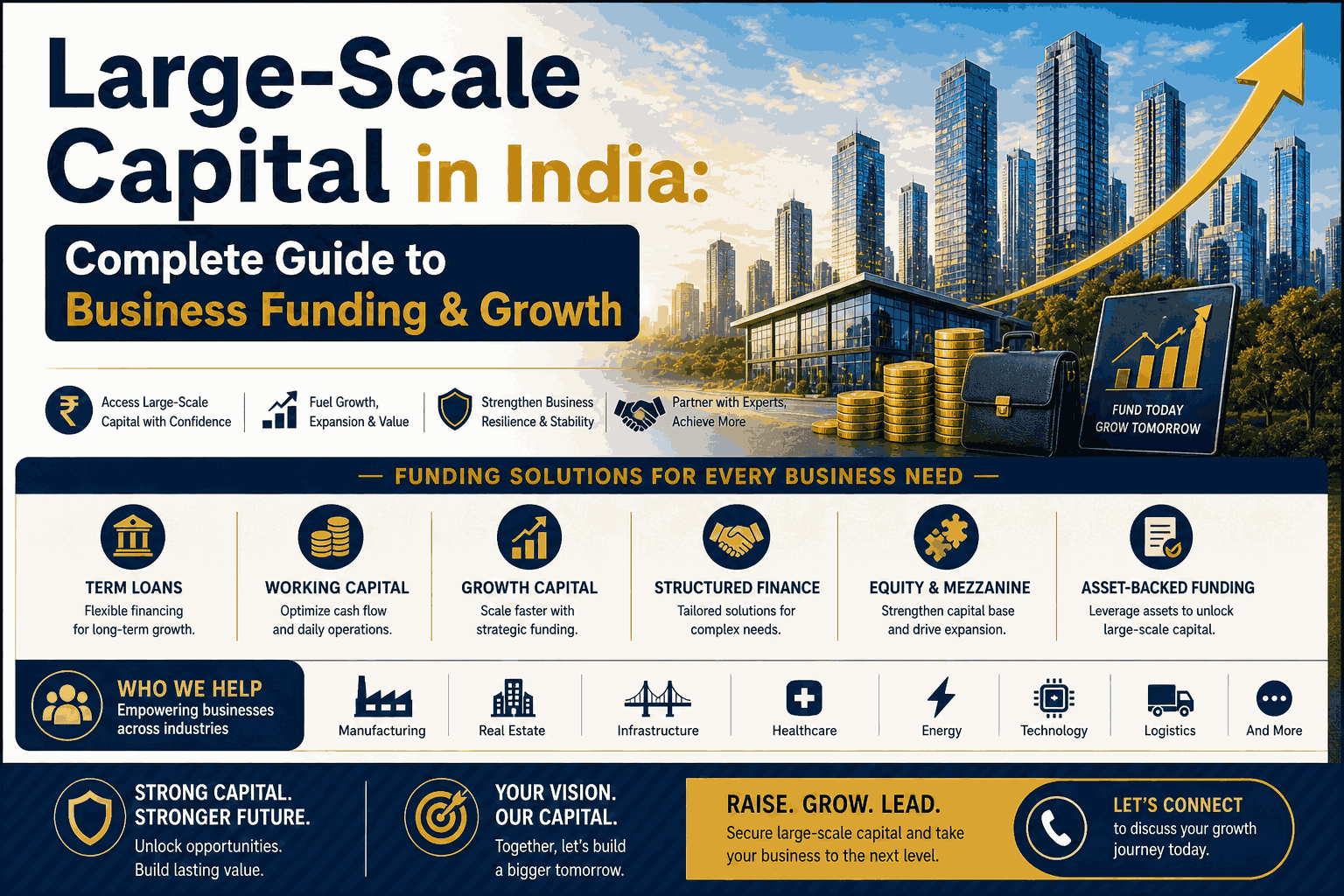
Large-Scale Capital: The Ultimate Guide to Funding Big Business Growth in India
Introduction
In today’s competitive business environment, growth is no longer optional—it’s essential. Whether you are planning infrastructure expansion, entering new markets, acquiring assets, or scaling operations, one critical factor determines your success: Large-Scale Capital.
Large-scale funding is the backbone of ambitious business strategies. Unlike small business loans or working capital financing, large-scale capital is designed to support high-value investments that can transform a company’s future. In India’s rapidly evolving economic landscape, access to structured capital solutions has become easier, yet navigating the right funding option remains a challenge for many businesses.
This guide will help you understand what large-scale capital is, its importance, sources, benefits, challenges, and how to secure it effectively.
What is Large-Scale Capital?
Large-Scale Capital refers to substantial financial resources required by businesses to fund major investments such as:
- Infrastructure development
- Industrial expansion
- Mergers and acquisitions
- Real estate projects
- Technology upgrades
- Business restructuring
Typically, this type of funding ranges from crores to hundreds of crores, depending on the scale of operations.
Unlike short-term financing, large-scale capital is usually structured with long-term repayment plans and may involve multiple stakeholders such as banks, NBFCs, private equity firms, or institutional investors.
Why Large-Scale Capital is Important for Businesses
1. Enables Business Expansion
Without sufficient capital, scaling operations becomes difficult. Large-scale funding allows companies to expand manufacturing capacity, open new branches, or enter international markets.
2. Supports Strategic Investments
From adopting new technology to acquiring competitors, strategic decisions often require significant funding.
3. Strengthens Market Position
Companies with access to large-scale capital can act faster, innovate better, and outperform competitors.
4. Drives Economic Growth
At a macro level, large-scale investments contribute to employment generation, infrastructure development, and overall economic progress.
Types of Large-Scale Capital
1. Debt Financing
This includes loans from banks, NBFCs, or financial institutions. Businesses repay the borrowed amount with interest over time.
Examples:
- Term loans
- Project financing
- Asset-backed loans
2. Equity Financing
In this method, businesses raise capital by offering ownership stakes to investors.
Examples:
- Private equity
- Venture capital
- IPO (Initial Public Offering)
3. Hybrid Financing
A mix of debt and equity, offering flexibility in repayment and ownership dilution.
4. Asset-Based Financing
Businesses leverage their assets such as land, property, or machinery to secure funding.
Key Sources of Large-Scale Capital in India
1. Banks and Financial Institutions
Traditional banks remain one of the most trusted sources for large-scale funding, especially for established businesses.
2. Non-Banking Financial Companies (NBFCs)
NBFCs provide more flexible lending options compared to banks, especially for businesses with complex financial structures.
3. Private Equity Firms
These firms invest in businesses with high growth potential in exchange for equity.
4. Venture Capital
Ideal for startups and high-growth companies looking for significant funding.
5. Capital Markets
Companies can raise large-scale capital through IPOs or bond issuance.
6. Alternative Investment Funds (AIFs)
AIFs are becoming increasingly popular for structured large-scale investments in India.
Benefits of Large-Scale Capital
1. Accelerated Growth
Access to substantial funds allows businesses to execute expansion plans quickly.
2. Improved Cash Flow Management
Large-scale capital ensures that businesses can manage operational expenses without disruptions.
3. Competitive Advantage
With better resources, companies can invest in innovation, marketing, and talent acquisition.
4. Flexibility in Operations
Structured funding solutions provide flexibility in repayment and utilization.
Challenges in Securing Large-Scale Capital
1. Strict Eligibility Criteria
Lenders and investors often require strong financial records, collateral, and creditworthiness.
2. High Documentation
The process involves extensive due diligence, legal documentation, and compliance.
3. Risk of Debt Burden
Improper planning can lead to financial stress due to high repayment obligations.
4. Equity Dilution
In equity financing, business owners may lose partial control of their company.
How to Secure Large-Scale Capital Successfully
1. Build a Strong Business Plan
A detailed business plan is essential to attract investors or lenders. It should include:
- Financial projections
- Market analysis
- Growth strategy
- Risk assessment
2. Maintain Financial Transparency
Clear and accurate financial records increase credibility and trust.
3. Leverage Assets
Using assets like land or property can improve your chances of securing funding.
4. Choose the Right Funding Partner
Not all funding sources are suitable for every business. Evaluate options carefully.
5. Seek Expert Guidance
Financial advisors or funding consultants can help structure deals effectively.
Role of Asset-Backed Financing in Large-Scale Capital
One of the most effective ways to secure Large-Scale Capital is through asset-backed financing. Businesses can unlock the value of their existing assets without selling them.
Advantages:
- Lower interest rates
- Higher loan amounts
- Faster approvals
- Retained ownership of assets
This method is especially beneficial for businesses with high-value land or property holdings.
Large-Scale Capital for Different Industries
1. Real Estate
Funding is required for land acquisition, construction, and project development.
2. Manufacturing
Capital is used for machinery, raw materials, and plant expansion.
3. Infrastructure
Large-scale funding supports roads, bridges, and energy projects.
4. Technology
Tech companies require capital for R&D, innovation, and scaling operations.
Future of Large-Scale Capital in India
India is witnessing a surge in demand for Large-Scale Capital, driven by:
- Rapid industrialization
- Government initiatives like Make in India
- Growth of startups and unicorns
- Increasing foreign investments
With evolving financial instruments and digital lending platforms, access to large-scale funding is expected to become more streamlined and efficient.
Common Mistakes to Avoid
- Ignoring financial planning
- Choosing the wrong funding source
- Over-leveraging debt
- Lack of risk management
- Poor documentation
Avoiding these mistakes can significantly improve your chances of securing and managing large-scale capital effectively.
Conclusion
Large-Scale Capital is the driving force behind major business transformations. Whether you are expanding operations, investing in infrastructure, or entering new markets, having access to the right funding can make all the difference.
However, securing large-scale capital requires careful planning, financial discipline, and the right strategy. By understanding the various funding options and aligning them with your business goals, you can unlock new growth opportunities and achieve long-term success.
If leveraged wisely, large-scale capital is not just funding—it’s a powerful tool to scale, innovate, and lead in today’s competitive market.
الأقسام
إقرأ المزيد
What is the current landscape of the endoscopy devices market?The endoscopy devices market is witnessing consistent growth as healthcare providers increasingly adopt minimally invasive procedures for diagnosis and treatment. According to Straits Research, the endoscopy devices market size was valued at USD 61.91 billion in 2025 and is projected to reach USD 84.52 billion by 2034, growing at a...

Cloud FinOps Market Information: The market research report on the Global Cloud FinOps market offered by Straits Research analyzes the major opportunities and yearly growth rates to help the readers to understand the qualitative and quantitative aspects of the Cloud FinOps industry. The competition landscape, company overview, financials, recent developments, and long-term investments...

Smart Kitchen Appliances Market Synopsis 2025: New York, United States, The purpose of this section's research is to study the Smart Kitchen Appliances Market during the course of the estimated period using several confirmed parameters based on Porter's Five Forces Model. As a result, a thorough inspection of the market helps in recognizing and emphasizing the market's crucial strengths...

A professional Deep Cleansing Facial in Dubai is a highly structured clinical procedure that follows a specific medical sequence to ensure the skin is thoroughly purified without compromising its integrity. Unlike a standard relaxation facial, this treatment is designed as a "corrective" session. Each step—from the initial enzymatic breakdown to the final barrier-sealing...

Easter Gaming Promotion at Canterbury League Club – Win Big This Festive Season! Celebrate the Easter season with excitement, rewards, and thrilling opportunities at the Canterbury League Club in Sydney. The Easter Gaming Promotion brings together festive fun and gaming entertainment, giving members a chance to enjoy exclusive rewards, promotions, and exciting prize opportunities. 🎰 What...